Listen


 Facebook
 Nextdoor
 X
 WhatsApp
 Email
 Copy link

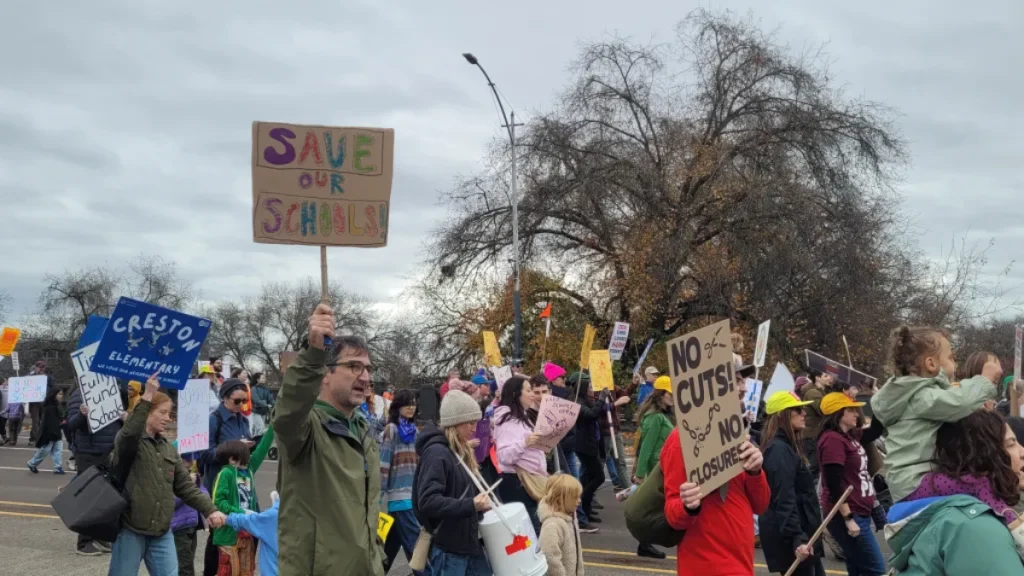
Parents, teachers and students marched across Portland on Saturday after Portland Public Schools recommended closing 10 schools, KOIN reported.
Superintendent Kimberlee Armstrong announced the plan on Friday, KOIN reported. The closures would take place over the next two years. Portland Public Schools said falling enrollment is a driver for the closures.
March crossed Burnside Bridge to park
Parents from Beach Elementary joined the Portland Association of Teachers march on Saturday morning, KOIN reported. The march started at the teachers union office in Northeast Portland. It crossed the Burnside Bridge and ended at Tom McCall Waterfront Park.
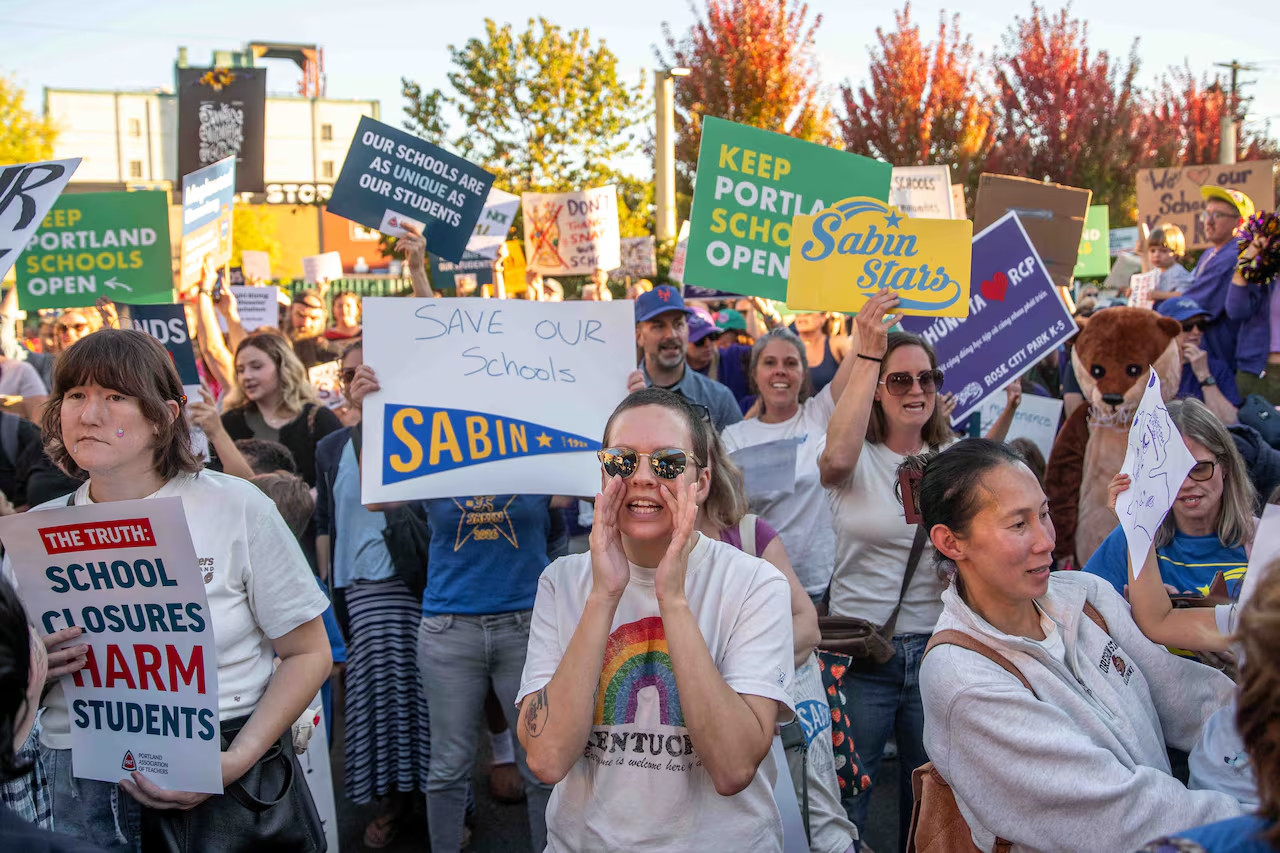
Beach Elementary student Carmela Vander Meer said she was sad to hear the news, KOIN reported. She said students had built a strong community with friends at the school. Robert Vander Meer is a parent at Beach Elementary.
“It brings up transportation problems for a lot of families as just how they’re going to get their kids there.” Robert Vander Meer said this about the plan. “They’re pulling them out of the organic communities that they have in their neighborhoods,” Robert Vander Meer said.
Kernan Willis is a special education teacher at Peninsula Elementary, KOIN reported. He said he worried his caseload would grow. He said he might not be able to provide the legally specially designed instruction in students’ individualized education plans.
District cites falling enrollment and deficit
All of them are elementary schools east of the Willamette River, OregonLive reported. Since 2019, Portland Public Schools has lost 6,000 students. That is enough to fill four high schools.
The decline comes mainly from a falling birthrate, OregonLive reported. The pandemic era’s long building closures also added to the drop.
Portland’s slow economy and high housing prices also played a part, OregonLive reported. Growing interest in virtual learning and home schooling also added to the drop.
About half of the district’s 40-plus elementary schools now enroll fewer than 300 students, OregonLive reported. Most are in buildings built to house at least 450 students. Most now have multiple grades in a single classroom.
The district still needs to cut \$65 million from its 2027-28 budget, OregonLive reported. Armstrong and district leaders said closing some schools would improve the student experience. Staff would be spread less thin, and teachers in the same grade would have more chances to work together.
Sam Baraso is a parent at Sabin Elementary School, OregonLive reported. “It’s hard for me to believe the district at this point that things will be different.”
“That resources will actually come,” Sam Baraso said.
Plan changed after weeks of criticism
Armstrong removed Sellwood Middle School from the list, OregonLive reported. She also removed Stephenson Elementary and Maplewood Elementary in Southwest Portland and James John Elementary in North Portland. The first two plans had sketched the closure of up to 14 schools.
Those plans included 13 elementary schools from around the city plus Sellwood Middle School in Southeast Portland, OregonLive reported. They also included boundary changes and program shifts. Armstrong had signaled the Sellwood change during a school board meeting in early November.
Armstrong recommended that Sunnyside Environmental School keep its environmental justice curriculum for its remaining K-5 students, OregonLive reported. She also decided not to move Skyline K-8 high schoolers to Roosevelt High. They would remain at Lincoln High School instead.
The change would have sent them across the Willamette River and over the St. Johns Bridge, OregonLive reported.
It would have been the first time Portland Public Schools students were zoned for a school across the river. Armstrong also acted on earthquake safety and traffic concerns raised by families at Skyline K-8, OregonLive reported.
Armstrong proposed putting off the closure of four elementary schools, OregonLive reported. The delay is a nod to concerns about the district.
The district lacks the ability to pull off a move of this size in one year, OregonLive reported. The district is also heading into tense labor talks.
Firiel Elliott has a third grader at Buckman Elementary, OregonLive reported. “I question their ability to adequately address the serious logistical challenges of our own school,” Firiel Elliott said.
She said families need more time to work with the district. That time would help make sure the plan makes sense and will work.
Armstrong stuck with plans to create “hub” sites on the east side. The sites are for Spanish and Mandarin dual language immersion schools, OregonLive reported.
Portland offers K-12 immersion programs in five languages, OregonLive reported. The plan also phases out seven of the city’s K-8 schools to boost student numbers in traditional middle schools.
Under the plan, Creston Elementary School in Southeast Portland would close, OregonLive reported. Most of its students would move to Atkinson Elementary. Its deaf and hard-of-hearing students would move to Glencoe K-5.
Lauren Green is the parent of a deaf and hard-of-hearing child, OregonLive reported. The child attends a special program at Creston Elementary School.
She said the move would upend a vulnerable and tight-knit community. She said the Columbia Regional Inclusive Services program and Creston should stay as they are.
What happens next for board vote
Armstrong will formally present her final plan on Tuesday, OregonLive reported. She will present it to the seven members of the Portland Public Schools board.
The Portland Association of Teachers organized the march and rally at 10 a.m. Saturday, OregonLive reported. It is organizing another rally before Tuesday’s board meeting.
Many parents at schools that remain on the list remain firmly opposed to the plans, OregonLive reported.
Armstrong’s new plan will be considered by the board, KOIN reported. There will be more chances for community input before the vote. The board is scheduled to vote on Dec. 15.